





The stable version of Android 17 was released on June 16, 2026. Eligible Xiaomi, REDMI, and POCO phones and tablets are already receiving updates based on the new system.
In this article, we’ll break down which Xiaomi phones will get the update and when to expect the HyperOS update based on Android 17 Cinnamon Bun (index X).
Android 17 Release Date
In June 2026, Google released the final version of Android 17. Google Pixel devices were the first to receive the stable update.
The update then begins rolling out to smartphones from Xiaomi, REDMI, POCO, Samsung, OnePlus, OPPO, vivo, realme, and other brands.
Key dates:
- July 14, 2026: the first global versions of Android 17 have been released for the Xiaomi 15T Pro and Xiaomi 17.
- July 2, 2026: launch of the Android 17 beta test on the Xiaomi 17 and Xiaomi 17 Ultra in China.
- June 16, 2026: release date of the stable version of Google Android 17.
- April 29, 2026: launch of the global Android 17 Developer Preview program for the Xiaomi 15T Pro, Xiaomi 17, Xiaomi 17 Ultra, and Xiaomi 17 Leica Edition.
Supported Xiaomi, REDMI, and POCO phones and tablets will receive the new version as part of HyperOS 4 based on Android 17. The update’s release date depends on when the beta test ends and on the firmware region (China, Global, EEA, and others). Usually, devices with China firmware receive the new version first, after which the update gradually spreads to global and regional versions.
Android 17 Beta Test on Xiaomi
In early July, Xiaomi opened recruitment for the closed beta testing of Android 17, the Xiaomi Pengpai OS 3 Early Beta. Owners of the Xiaomi 17 and Xiaomi 17 Ultra in China can apply.
To participate, the device must be updated to one of the following HyperOS versions:
- Xiaomi 17: OS3.0.315.0.WPCCNXM
- Xiaomi 17 Ultra: OS3.0.308.0.WPACNXM
The beta firmware integrates Android 17 features, including improved multitasking, new functions for foldable devices, expanded privacy settings, and deeper artificial intelligence integration.
China traditionally gets the beta first. Recruitment of global Android 17 testers is expected about a month after the Chinese round, in August 2026.
Android 17 Global Developer Preview
The program launched in late April 2026. It gives developers early access to Android 17 and is intended for testing new features and checking app compatibility.
The program is available on four global models. To install the preview version, the device must be running one of the supported HyperOS builds:
- Xiaomi 17: OS3.0.301.0.WPCMIXM
- Xiaomi 17 Ultra: OS3.0.9.0.WPAMIXM
- Xiaomi 17 Ultra Leica Edition: OS3.0.9.0.WPAMIXM
- Xiaomi 15T Pro: OS3.0.11.0.WOSMIXM
Two files are available for each smartphone: the Developer Preview build for testing and a ROM for rolling back to stable firmware.
You can download the Android 17 Beta Build from the official site (current links are at the bottom of the page).
Xiaomi Android 17 eligible devices
The official mi.com site has published smartphones and tablets with the AER marking, which indicates their compatibility with past and future Android versions:
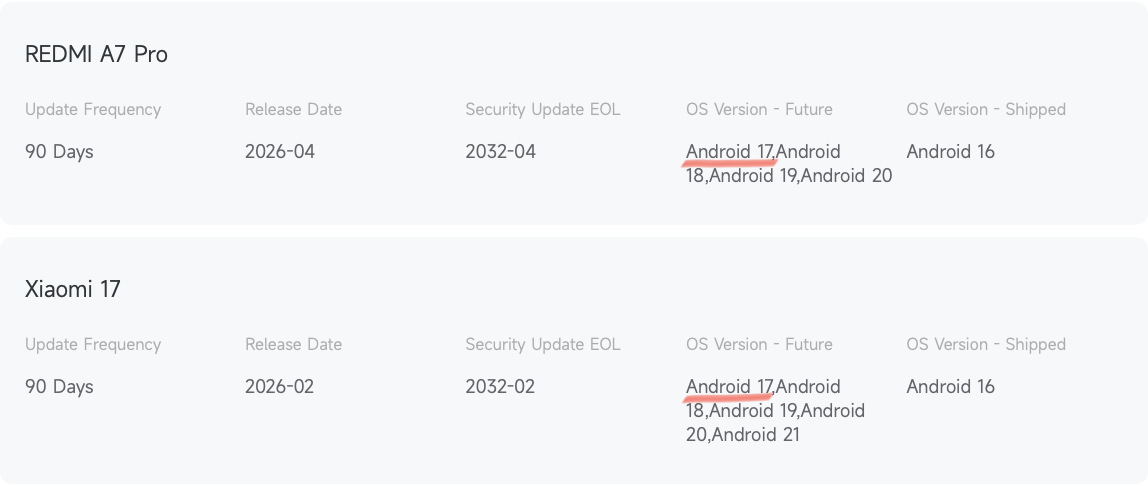
AER (Android Enterprise Recommended) is a Google certification confirming that a smartphone meets requirements for security, stability, and regular updates.
Based on this data, we can compile a list of Xiaomi, REDMI, and POCO devices that will receive the Android 17 update. We’ll add to this list the new models that are certain to be updated.
Xiaomi Android 17 update list:
- Xiaomi 17, Xiaomi 17 Max, Xiaomi 17 Pro, Xiaomi 17 Pro Max, Xiaomi 17 Ultra, Xiaomi 17T, Xiaomi 17T Pro
- Xiaomi 15, Xiaomi 15 Pro, Xiaomi 15 Ultra, Xiaomi 15S Pro, Xiaomi 15T, Xiaomi 15T Pro
- Xiaomi 14, Xiaomi 14 Civi, Xiaomi 14 Pro, Xiaomi 14 Pro Ti Satellite, Xiaomi 14 Ultra, Xiaomi 14T, Xiaomi 14T Pro
- Xiaomi 13T, Xiaomi 13T Pro
- Xiaomi Civi 4 Pro, Xiaomi Civi 5 Pro
- Xiaomi MIX Flip, Xiaomi MIX Flip 2, Xiaomi MIX Fold 4
- Xiaomi Pad 9
- Xiaomi Pad 8, Xiaomi Pad 8 Pro
- Xiaomi Pad 7, Xiaomi Pad 7 Pro, Xiaomi Pad 7 Ultra, Xiaomi Pad 7S Pro 12.5
- Xiaomi Pad Mini
The Xiaomi 13 Lite, Civi 3, the Xiaomi 12 and 11 lineups, and earlier models will not be updated.
The Xiaomi Pad 6S Pro 12.4, as well as the Xiaomi 13, 13 Pro, 13 Ultra, and MIX Fold 3, could theoretically receive Android 17, but there is no official confirmation yet.
REDMI Android 17 update list:
- Redmi K100 Pro, Redmi K100 Pro Max
- REDMI M100
- REDMI K90, REDMI K90 Max, REDMI K90 Pro Max, Redmi K90 Ultra
- REDMI K80, REDMI K80 Pro, REDMI K80 Ultra
- REDMI K70, REDMI K70 Pro, REDMI K70 Ultra
- REDMI 17, REDMI 17 5G, REDMI 17 5G China, REDMI 17C, REDMI 17C 5G
- REDMI Note 17 4G, REDMI Note 17 5G, REDMI Note 17 Pro 5G, REDMI Note 17 Pro Max 5G
- REDMI 15, REDMI 15 5G, REDMI 15A 5G, REDMI 15C, REDMI 15C 5G, REDMI 15R 5G
- REDMI Note 15 4G, REDMI Note 15 5G, Redmi Note 15 Pro 4G, REDMI Note 15 Pro 5G, REDMI Note 15 Pro Plus 5G, REDMI Note 15 SE 5G, REDMI Note 15R
- REDMI Note 14 4G, REDMI Note 14 Pro 4G, REDMI Note 14 Pro 5G, REDMI Note 14 Pro Plus 5G
- REDMI A7 Pro 5G
- REDMI R70 5G, REDMI R70m
- REDMI K Pad, REDMI K Pad 2
- REDMI Turbo 4, REDMI Turbo 4 Pro, REDMI Turbo 5, REDMI Turbo 5 Max
- REDMI Pad 2, REDMI Pad 2 4G, REDMI Pad 2 9.7, REDMI Pad 2 Pro, REDMI Pad 2 Pro 5G, REDMI Pad 2 SE, REDMI Pad 2 SE 4G
While Xiaomi devices get three Android versions, REDMI phones and tablets have historically been limited to two updates, except for the REDMI K and REDMI Note series. As a result, all REDMI 14 and 13 models, the REDMI A3/A4, and the REDMI Turbo 3 will continue running their current OS. There is no official information on the REDMI Note 14S yet, but a chance for an update remains.
Starting with the REDMI Note 13 series, Note smartphones began receiving three OS updates. However, this rule did not apply to the 13R model. For the same reason, the REDMI Note 14 5G does not support Android 17, although the other phones in the REDMI Note 14 lineup will be updated.
The REDMI Note 12 and earlier models will remain on Android 16, as will the REDMI Pad Pro, REDMI Pad Pro 5G, REDMI Pad SE 8.7, SE 8.7 4G, and older devices.
Models with the “REDMI K” designation historically receive three OS updates. All smartphones in the REDMI K50 and K60 series have exhausted their limit and are completing their cycle of major updates.
Some phones and tablets are missing from the official AER list on mi.com. For example, some POCO-brand devices are on the list, but current models are not there at the moment.
In the brand’s entire history, only the POCO M6 Pro and POCO X6 5G have received three Android versions; all others got two. Since there is no official information on POCO devices yet, the list can be compiled based on devices that have received no more than one Android update.
POCO Android 17 update list:
- POCO C95 Pro
- POCO C85, POCO C85 5G
- POCO C81, POCO C81 Pro
- POCO F9 Pro, POCO F9 Ultra
- POCO F8 Pro, POCO F8 Ultra
- POCO X8, POCO X8 Power, POCO X8 Pro, POCO X8 Pro Max
- POCO M8 5G, POCO M8 Power 5G, POCO M8 Pro 5G, POCO M8s 5G, POCO M8x 5G
- POCO F7, POCO F7 Pro, POCO F7 Ultra
- POCO X7 Pro
- POCO M7, POCO M7 Plus 5G
- POCO Pad C1, POCO Pad M1, POCO Pad X1
Some POCO smartphones may be updated a third time (like the POCO M6 Pro and X6 5G). So if your device is not on the list above, don’t lose hope until official information appears.
People often ask whether the POCO X6 Pro will get the Android 17 update. The POCO X6 Pro has already received two Android updates, which is the standard limit for most POCO smartphones, so it is not on the confirmed list. An exception is possible, but there is no official confirmation yet.
The POCO C71 runs on Android Go, and such models are updated differently than smartphones on MIUI or HyperOS. In theory, the device could receive an update, but there is no official information yet. It’s worth considering only after the smartphone has been updated to Android 16.







The Poco X7 is still new, so why isn’t it included in the Android 17 and HyperOS 4 update list?
The article explains the basis for these assumptions. We need to wait for official information to be released.
Vreau va rog Android 16 și 17 & 18 și tot așa mai de parte se poate mersiiii mult